
Carling Dalenson Gallery is pleased to present the exhibition Grace, featuring a diverse selection of works by the American photographer Robert Mapplethorpe (1946–1989). The exhibition opens 19 November and runs through 31 January 2027.
Robert Mapplethorpe was one of the most influential figures in twentieth-century photography. He was born in Queens, New York ans grew up in the nearby suburb of Floral Park. He enrolled at Pratt Institute in Brooklyn in 1963, where he studied graphic arts, drawing, painting, and sculpture. He began, in his early years, to produce drawings, collages, assemblages, and jewelry incorporating found objects and images taken from books and magazines. Influenced by artists such as Joseph Cornell and Marcel Duchamp, he gradually incorporated photography, extending his mixed-media practice. His work, rooted in portraiture, the nude, flowers, and still life, is characterized by precision and a lasting interest in the human body and classical ideals of beauty and harmony.
Across very different subjects, Mapplethorpe’s photographs share carefully arranged compositions and sculptural light. His photographic practice was developed in the 1970s: Sandy Daley introduced him to the Polaroid camera in 1970, and in 1975 his patron and mentor Sam Wagstaff gave him a Hasselblad, which became instrumental in shaping his distinctive style. His portraits range from intimate studies of friends and artists to commissioned photographs of prominent cultural figures and celebrities. In 1980 he met Lisa Lyon, the first World Women’s Bodybuilding Champion, with whom he developed an extensive collaboration of portraits, figure studies, a film, as well as the book Lady: Lisa Lyon.
Mapplethorpe’s work is closely tied to the cultural world of New York in the 60s, 70s, and 80s. His companionship with Patti Smith, whom he met in 1967, was particularly important to his early development, and in 1969 the two moved into the Chelsea Hotel, becoming part of downtown New York’s emerging artistic community. Figures from this community also became Mapplethorpe’s objects of artistic inquiry: he photographed artists, musicians, actors, socialites, and members of the underground scene, and alongside his personal work produced album covers for Patti Smith and groundbreaking groups like Television, as well as portraits and party photographs for Andy Warhol’s magazine Interview.
In the second half of the 1970s, Mapplethorpe turned to New York’s gay male S&M subculture, photographing people and places who were largely absent from the mainstream visual culture. Personally involved in the community, he earned the trust of his subjects. The resulting works, regarded as his most controversial, combine explicit imagery with a very formal approach. Mapplethorpe himself rejected the idea that his aim was simply to shock. His later publication The Black Book (1986) continued his exploration of the representation of the male body and phallic motives.
Although the human figure and the controlled image remained central to everything Mapplethrope did, he continually experimented with processes and formats. He worked for instance with large-scale polaroids, photogravures, platinum prints on paper and linen, cibachrome, and dye-transfer color printing. His projects also extended beyond photography, including the set design for Lucinda Childs’s dance performance Portraits in Reflection (1986) and a series of photogravures illustrating Arthur Rimbaud’s A Season in Hell (1873).
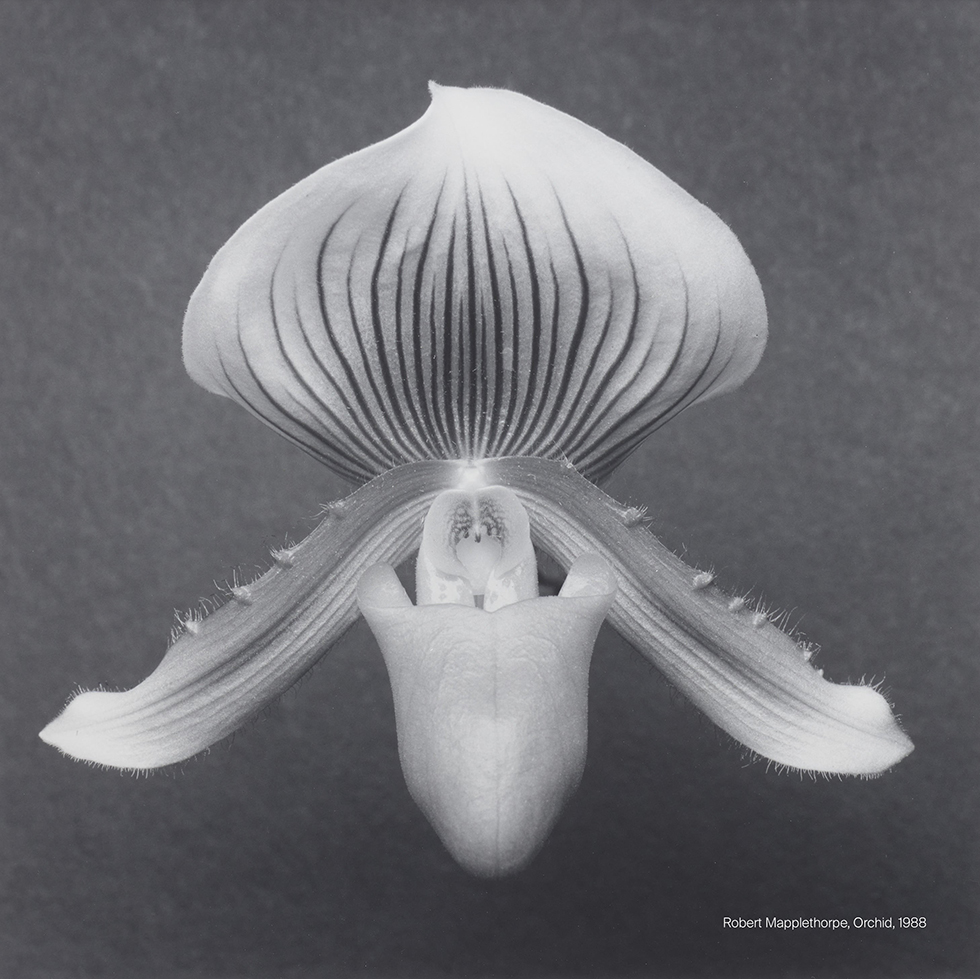
Robert Mapplethorpe, Orchid, 1988.
Mapplethorpe’s first solo exhibition, Polaroids, was presented at the Light Gallery in New York in 1973. In 1977 he took part in Documenta 6 in Kassel, and in 1978 he joined Robert Miller Gallery. Despite being diagnosed with AIDS in 1986, he continued to work intensively. In 1988 the Whitney Museum of American Art presented his first major American museum retrospective. His final years also saw major exhibitions at the Stedelijk Museum in Amsterdam and the National Portrait Gallery in London. In 1989, Mapplethorpe passed away at the age of 42.
Following his death, a comprehensive retrospective, The Perfect Moment, was organized at the Institute of Contemporary Arts in Philadelphia. The exhibition was very well received by critics and the public, but also sparked a heated debate about state-funded cultural production and the support of sexually explicit art, with certain interest groups trying to censor what they deemed was “indecent” art. The debate has in retrospect been refered to as one of the first “culture wars” in the United States.
Mapplethorpe’s works are held in numerous public collections, including the Metropolitan Museum of Art, the Museum of Modern Art in New York, and the J. Paul Getty Museum. In 1988, one year before his death, The Robert Mapplethorpe Foundation was established with the mission of promoting photography, supporting museums exhibiting photographic art, and funding medical research in the battle against HIV/AIDS. The foundation continues to preserve and promote his legacy for future generations.

Carling Dalenson grundades 1994 och är ett privat, familjedrivet galleri som specialiserar sig på väletablerade samtida konstnärer från hela världen.
Utställningarna inkluderar konstnärer som familjen Carling Dalenson har samlat och stöttat genom åren, såsom Robert Rauschenberg, Andy Warhol, Frank Stella och Joel Shapi…

- Sibyllegatan 49, 114 42 Stockholm
- info@carlingdalenson.com
- https://www.carlingdalenson.com/
Öppettider:
Måndag & tisdag efter överenskommelse
Onsdag – fredag, 12 – 18
Lördag, 12 – 16